
Overview
Exploration Potential
District-Scale Opportunity
Beyond the defined resource, Courageous Lake is interpreted as a district-scale gold system with multiple exploration fronts.
Key Exploration Themes
Resource Expansion
- Step-out drilling along known mineralized trends
- Conversion of inferred to indicated resources
- Depth extensions of existing zones
Satellite Deposits
- Evaluation of nearby targets including Walsh Lake
- Identification of parallel mineralized structures
- Expansion of mine life potential through feed diversification
Regional Discovery Potential
- Untested geophysical and geochemical anomalies
- Structural corridors with limited historical drilling
- Potential for entirely new deposits within the land package
Land, Location, and Climate
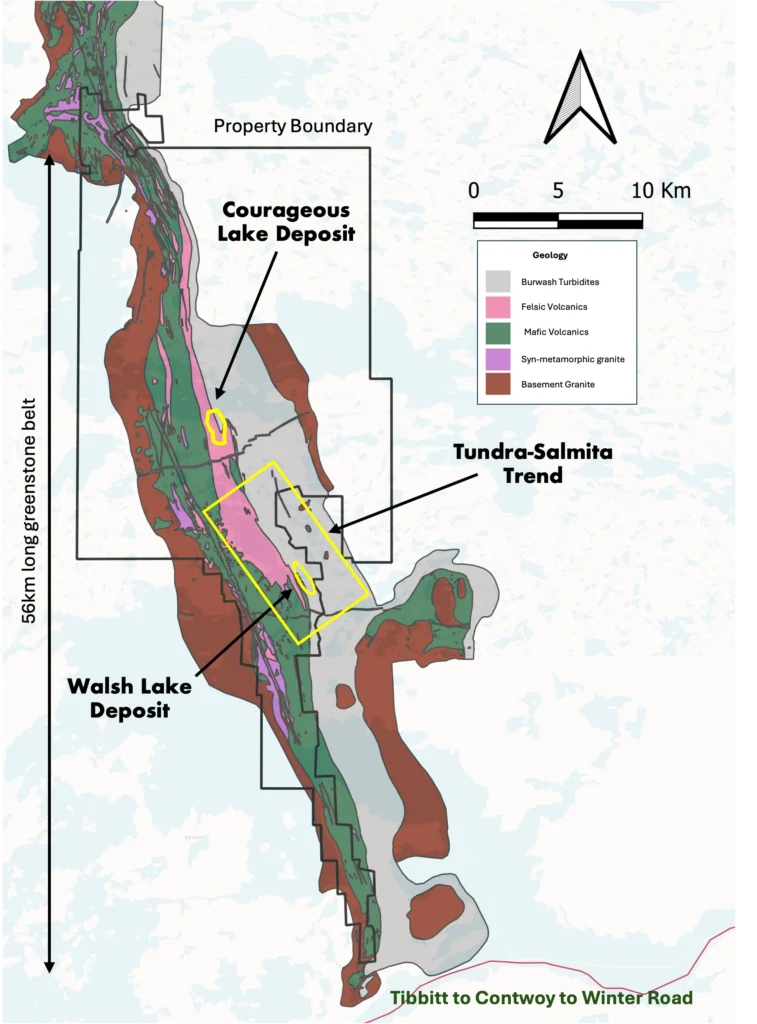
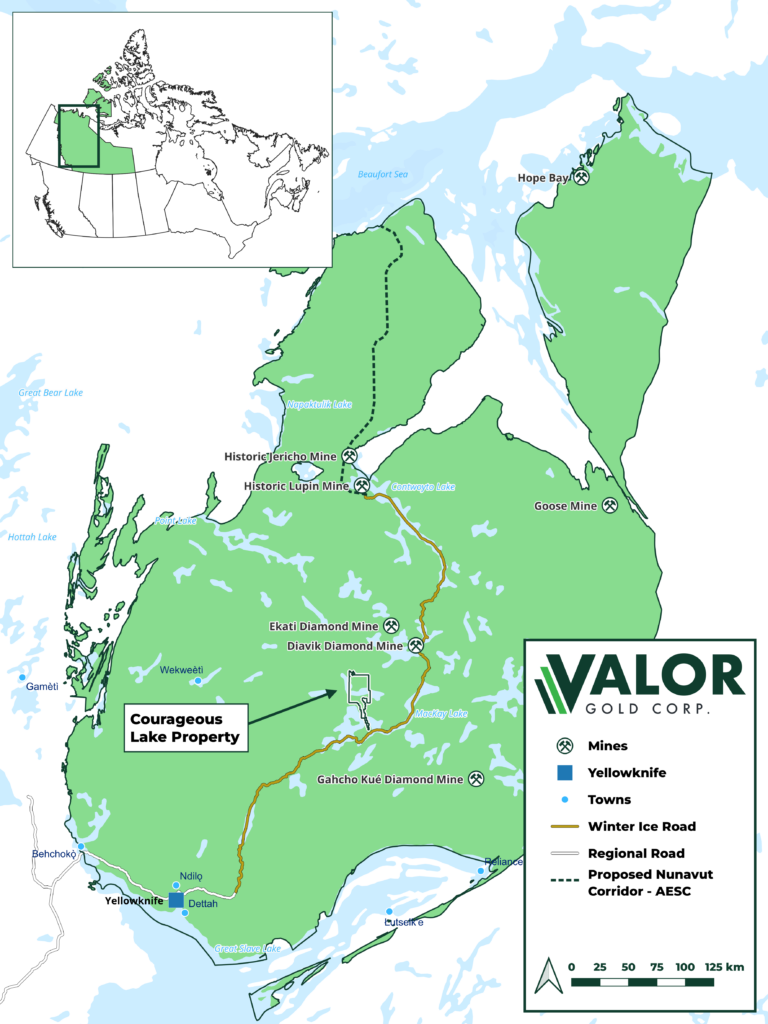
The Courageous Lake Property is 240 km northeast of Yellowknife NWT, Canada. It is situated along the shores of Mathews Lake, between the larger Courageous Lake to the north and MacKay Lake to the south. Coordinates for the center of the deposit are about 486,700 East and 7,109,600 North (NAD83 Universal Transverse Mercator). Access to the project is by fixed wing aircraft or helicopter between February and April. A 35 km spur road can be constructed to link with the Tibbitt to Contwoyto winter road.
The site is characterized by undulating hills to the west and flatter terrain to the east with associated tundra vegetation. Low-lying marshy areas connect open lakes in the tundra and subdued rounded rock outcrops surround these bodies of water. At nearly 640 North, temperatures are often below freezing but between late May and August +20C temperatures are common.